
That was my experience of Snowdon – an A-list mountain. Standing at 1,085 metres, it’s the highest point in Wales and every year attracts hordes of people who want to stand on top of it. Such is its pull that there’s a cafe at the summit, a train (courtesy of the Victorians) to take you up it, and a whole network of paths leading from the overflowing car parks at its base.
I remember standing one summer on Snowdon, practically shoulder to shoulder with other walkers, queuing to reach the summit. The place was so noisy with selfie-takers there was no space to enjoy the actual things that drew me there – the peace, the tranquility, and the beauty of being in the mountains. So I made a decision to stop being a height snob and start checking out the peaks that no one talks about.
But it wasn't just about the mountains. Exploring Wales means also experiencing its hospitality. If you plan to visit and are looking for a place to stay, you might want to consider checking out some of the accommodations listed on http://www.hotels-wales.com/en/. It's a good resource with a broad range of options — surely you will find something that suits your taste and budget.
And if you want another resource that provides various options not just in Wales but also in other parts of the United Kingdom, you may want to visit tophotels.com. It features an extensive list of top-rated hotels across the cities. You might find a gem where you'll lay your head after a long day of mountaineering.
Taking out an Ordnance Survey map, I scoured the national park and, across the valley to the south-east, spotted a small hill called Yr Arddu. At just 389 metres it was never going to attract the hard-core mountaineers, but rising above the little-driven road in the Nantmor valley, it wouldn’t attract the crowds either.
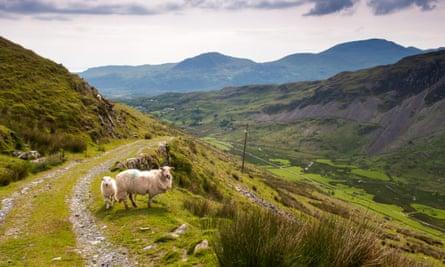
Seeking an adventurous and less crowded alternative, I deviated from the bustling traffic en route to Pen-y-Pass car park, opting for a scenic B road. This secluded route was a haven for sheep, outnumbering cars by a significant margin. Arriving at a compact clearing that could accommodate just a few vehicles, I strolled alongside the river until I reached a stile.
Gazing upwards, my eyes fixated on my destination - a lofty summit that exuded grandeur without feeling overwhelming. Wandering past inquisitive ewes, unaccustomed to encountering hikers, I proceeded along a steep yet faint trail, immersing myself in the earthy aroma of the forest floor while the sound of babbling water accompanied me on my right.
As I ascended, the mapped route appeared to fade away. Undaunted, I embraced the thrill of forging a new path rather than following the footsteps of many.
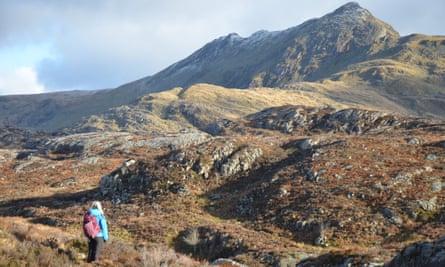
Formerly the spoils of a volcano, the tufts of igneous rock protruded from the grass, peppering the flanks with pewter sprinkles. I realised I would have to start using my hands if I wanted to reach the top.
I’ve always loved scrambling, the point on a mountain between simple walking and actual climbing. To do the easiest level – as this one was – you need no special equipment, no ropes or harnesses, just a level head. But it doesn’t stop it being exciting: feeling the stone beneath your hands, having to pick out the route ahead, checking the rocks for a firm hold before committing, covering steep ground quickly. As I moved steadily upwards I felt like a proper explorer. A proper explorer at just over 300 metres.
When the rocks began to thin, and tussocks of grass became the constant once more, I began to make out the summit ahead. To the left was the pocket of water called Llyn yr Arddu – the perfect place for a wild camp for another trip – ahead was the taller, shapely, peak of Cnicht – AKA the Welsh Matterhorn.

I took the last few steps to the cracked rocks and pile of stones that mark this pint-size peak’s summit and stopped to look over to Snowdon. Though it was late in the day I could still make out the dots of Gore-Tex descending back to the busy car park. Yet here I was with mountains around me in three directions, the sea on the other, quite alone.
I smiled. Let the crowds jostle to see their celebrity mountain, because climbing one of Snowdon’s supporting cast had proved that you don’t need to summit the highest mountain in the country to feel like you’re on top of the world.
Phoebe Smith is the author of Britain’s Best Small Hills (Bradt, £14.99). To order a copy for £12.74, including UK p&p, visit guardianbookshop.com or call 0330 333 6846
Discover Five More Captivating Peaks
Bow Hill in the South Downs: 206m
Unveiling a captivating history, this South Downs summit unveils the legendary Devil's Humps, Bronze Age barrows believed to be the resting place of fallen Viking leaders defeated by the Chichester locals. Adding to its mystique are the ancient yew trees, rumored to harbor the lingering presence of these Viking warriors.
Dumgoyne in Stirling: 427m
Steeped in mysticism, Dumgoyne stands tall amidst Stirling, beckoning adventurers to explore its majestic heights. This enchanting peak reveals breathtaking vistas and cascading waterfalls, captivating visitors with its allure. Set amidst a landscape of rugged beauty, Dumgoyne promises an unforgettable experience for those who dare to venture to its summit.

Located just over 22km from Glasgow, this volcanic plug offers a challenging climb with a rewarding finale. After conquering the summit, hikers can savor a well-deserved dram at Glengoyne distillery, which is nestled on the lower slopes.
Castle Crag, Lake District: 290m
Blessed with panoramic views of Borrowdale valley, this modest peak in the Lake District provides an adventurous experience for explorers. Delve into its lower flanks to uncover a hidden cave, once the dwelling place of Millican Dalton, an esteemed adventurer from the 1930s.
Meall Fuar-mhonaidh, Inverness-shire: 699m
Standing tall in Inverness-shire, Meall Fuar-mhonaidh reaches an impressive height of 699m. Embark on the climb and immerse yourself in the breathtaking landscapes that unfold along the journey.

For a unique and awe-inspiring experience at Loch Ness, venture to the peak that towers above the water. Immerse yourself in the picturesque surroundings adorned with heather and rocky terrain, and embrace the opportunity to catch a glimpse of a dinosaur-like fin, reminiscent of the legendary Loch Ness Monster.
Discover Moel Tryfan near Snowdonia: 427m
Ascending this compact mountain is a breeze and can be accomplished in just 20 minutes, covering a vertical distance of 127 meters. However, its historical significance is monumental. In 1842, renowned naturalist Charles Darwin chose this very location to delve into the study of glaciology. He observed that Moel Tryfan stood at the convergence point of two ice sheets 30,000 years ago, resulting in the accumulation of ocean debris and mountain deposits which shaped and defined the mountain we see today.
If you're looking for a quick adventure with breathtaking views and a touch of history, Moel Tryfan is the perfect destination. Don't miss the opportunity to follow in the footsteps of a scientific pioneer and witness the scenic splendor that awaits at the summit.